
Engineering Records · 3D Printing & CAD Prototyping
Designing a Modular Filament Spool Holder
Designing a functional filament holder that was larger than my printer could manufacture as one piece.
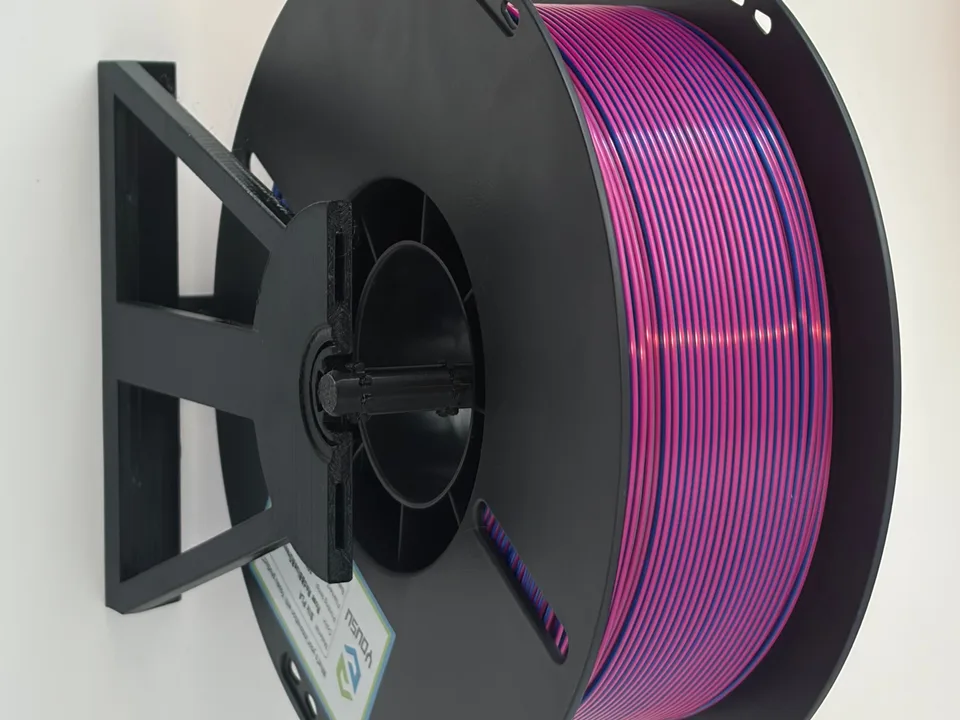
Finished Modular Spool Holder
The assembled spool holder supporting a full filament spool.
As I started collecting more filament, I needed a better way to organize and hold the spools around the printer.
That turned into a useful CAD problem because the object I wanted was larger than what my A1 Mini could manufacture as one piece.
The Problem
The A1 Mini has a 180 × 180 × 180 mm build volume.
That’s plenty of space for a lot of the things I make, but it becomes a real limitation when the finished object needs to span much farther than 180 mm.
The easiest solution would have been to make the holder smaller.
I didn’t really want to do that.
Instead, I decided to make the printer’s size part of the design problem.
Designing the Complete Structure First
I started by thinking about what I actually wanted the finished holder to look like and how the spool needed to sit inside it.
The holder needed to support the spool without using a huge amount of plastic, stay reasonably rigid, and leave enough clearance for the spool to rotate.
That produced a larger frame that worked as a complete design but obviously wouldn’t fit on the printer.
Breaking the Design Apart
Once the overall structure made sense, I started dividing it into smaller printable sections.
That meant the individual pieces needed to fit the build plate, but they also had to become a useful structure again after assembly.
The connection between the parts became part of the design instead of something I could figure out afterward.
This was one of the first times I really understood how a machine’s manufacturing limits can change the architecture of the object itself.
Planning the Print
The next question was whether the individual sections actually fit comfortably on the build plate.
The build-plate layout became another design check.
Instead of only looking at dimensions in Fusion, I could see whether the pieces made sense as printable objects and whether their orientation would create unnecessary supports or weak layer directions.
Building the First Version
The early physical version proved the basic idea.
It could support a spool and showed that the general frame geometry was workable.
It also gave me something much more useful than another CAD view: a real object I could load, handle, and compare against what I thought I had designed.
Revising the Holder
I continued adjusting the structure and eventually printed a cleaner later version.
The finished assembly can hold a full spool while being made from pieces that individually fit inside the A1 Mini’s much smaller build envelope.
What This Changed
The most useful part of this project wasn’t really the spool holder.
It was realizing that the printer’s build volume doesn’t necessarily need to be the size limit of the things I design.
It just means larger designs need an assembly strategy.
That idea is already starting to show up in some of my other CAD work.