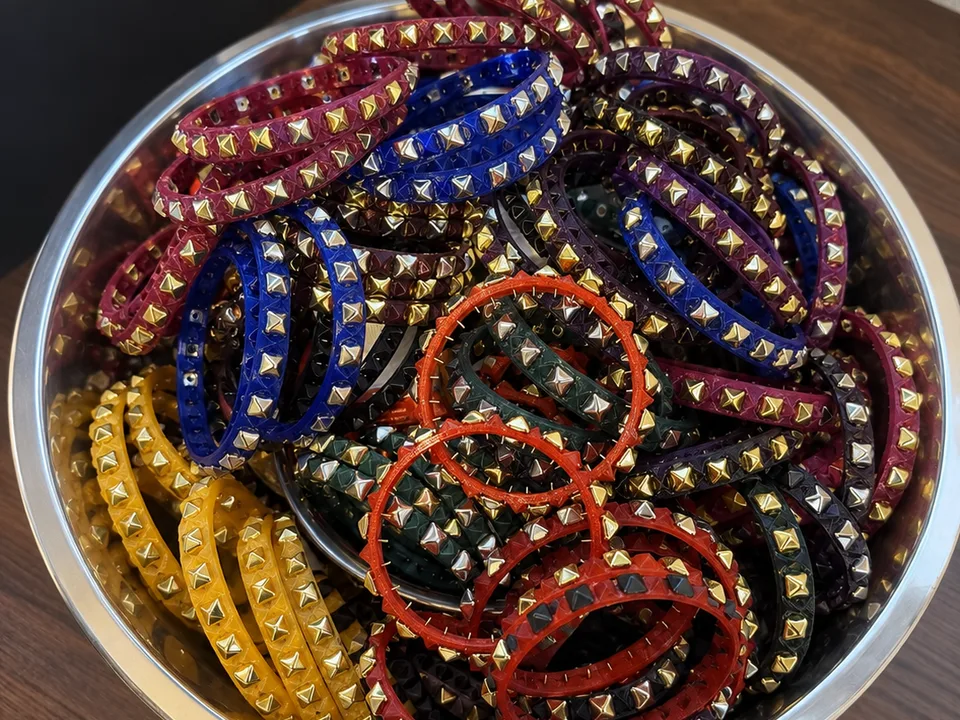
Jelly Bracelet — Fully Studded
A bold, flexible bracelet built around a continuous ring of four-sided pyramid studs. Produced in small batches from TPU.
$20.00
Bench-made in Corvallis, Oregon
Flexible TPU bracelets tuned for comfort and daily wear. Made to order in custom sizes and color combinations.
Products
1 product
A bold, flexible bracelet built around a continuous ring of four-sided pyramid studs. Produced in small batches from TPU.
$20.00
All proceeds go directly toward funding my engineering projects and further exploration with 3D printing.
Ordering Information
Measure the widest part of your knuckle, then compare that with the inner diameter of a round bangle that already fits. Standard inner diameters are Women's Small 57 mm, Medium 60 mm, and Large 63 mm. Custom inner diameter is a whole number from 50 mm through 80 millimeters. Custom sizes are excluded from fit and change-of-mind exchanges.
Flexible TPU bands and metal hardware assembled to order on the workbench in Corvallis, Oregon. Selected styles offer hardware choices and color combinations.
Each bracelet is made in 2-4 business days before dispatch. Carrier transit time is separate. Standard US shipping is $5, $10, or $15 at checkout and is not discounted.
Every piece is made to order. For sizing questions, custom requests, or order inquiries, reach out directly through the inquiry form.
Frequently Asked Questions
Have questions about materials, durability, or orders? Here is what you need to know.
Bands are fabricated from flexible thermoplastic polyurethane (TPU). This material provides elasticity, water resistance, and high tear strength while remaining soft against the skin.
Yes. The configurator lets you choose from our active print library colors. If you have a specific combination in mind that isn't listed, contact Kaden through the inquiry page.
Because these bangles slide over the hand rather than clasping, measure across the widest part of your hand when your knuckles are compressed together, or measure an existing bangle that fits well.
Want to see how these are engineered? Read the workbench build logs in Projects and follow the iterative testing process.